
.jpeg)
In today’s research landscape, the perception and reality of a conflict of interest (COI) carry significant weight - not only for individual researchers, but for institutional credibility and compliance. A conflict of interest occurs when a person’s external relationships, financial or otherwise, have the potential to influence - or appear to influence - the design, conduct, or reporting of research. When left undisclosed or unmanaged, COIs can erode trust, invite regulatory risk, and undermine research integrity.
For higher education institutions in particular, COI management is no longer just a matter of ethics - it’s a compliance imperative. Federal agencies, state laws, and institutional policies require disclosure of financial interests and outside commitments by those involved in research. Consider this: at the University of California‑Riverside, any “outside interest” related to an investigator’s institutional responsibilities must be reported via the institution’s COI office through the disclosure system. Whether you’re managing federal awards, industrial partnerships, or collaborative research, the presence of a perceived or actual conflict triggers scrutiny - not just for the individual, but for the entire institution.
At a high level, a COI arises when an individual’s personal or external interests could compromise - or be seen to compromise - their objectivity in research. These interests fall into two broad categories:
1. Financial conflicts.
This might include receiving consulting or equity in a company whose product you are studying, holding stock in a firm indirectly affected by your findings, or receiving reimbursed travel or gifts from a sponsor with a vested interest in results. Even if no unethical intent exists, unreported financial interests may undermine confidence in outcomes.
2. Non-financial conflicts.
Obligations such as outside employment, family members working for a company under review, or personal relationships can introduce bias or an appearance of bias. For example, if a researcher’s spouse holds a leadership role in an industry partner, that merits disclosure to ensure the research remains beyond reproach.
In many institutions, these relationships must be disclosed annually, as well as when new interests emerge. For instance, at Indiana University, individuals “responsible for the design, conduct, or reporting” of research must submit an annual research-related COI disclosure form - and within 30 days if any new interest arises.
In effect, if you’re involved in research as a principal investigator, co-investigator, key person, or consultant, you must ask yourself: Could my outside interest affect the integrity of my research, or make others question it? If the answer is “maybe,” disclosure is prudent.
Failing to appropriately disclose or manage conflicts can lead to a host of problems:
It’s worth noting that the disclosure process itself plays a crucial role in safeguarding the reputations of both institutions and researchers. For example, at the aforementioned UCR, submitting your outside financial interests into the institution’s COI system is not just policy - it’s a marker of accountability and governance.
The COI landscape continues to change. For example:
In short, institutions can no longer rely on annual paper disclosures tucked into binders - effective COI management demands a clear process, transparency, and modern tools.
To stay ahead of risk and maintain integrity, both individuals and institutions can adopt a proactive stance:
For researchers:
For institutions:
How technology supports COI management
Modern research institutions increasingly rely on automated systems to manage the COI process efficiently and effectively. For example, many universities use the disclosure module of the software system Kuali Research to support annual disclosures, updates, reviews, and links to proposals. At institutes such as Colorado State University, a COI module embedded in Kuali supports the review workflow, project declarations, and management plans.
By moving away from paper-based disclosures and manual routing, institutions gain:
Even configuring project-level “declarations” linked to outside entities is supported. As documented in Kuali’s knowledge base: “Conflict of Interest provides functionality that supports the reporter’s assessment of their disclosed relationships on their research projects before submission to COI Admins for review.”
Conflicts of interest can arise more easily than many realize, and the consequences of failing to disclose or manage them are real. But in today’s higher-education research environment, it’s not enough to rely on individual honor alone. Institutions need clear policies, timely training, modern systems, and proactive administration. Researchers must remain vigilant in fulfilling their obligations, accurately document relationships, and submit disclosures in a timely manner.
Ultimately, when an institution fosters a culture of transparency and supports it with efficient systems, everyone benefits: the researcher, the institution, the funding sponsor, and the broader public, which in turn fosters trust in academic research.
For institutions ready to streamline this aspect of research administration, a solution such as Kuali Research offers a comprehensive platform with modules for conflict of interest/commitment disclosures, project declarations, review workflows, and reporting. For more information, visit https://www.kuali.co/products/research to explore how it can help your institution manage COIs with confidence and efficiency.
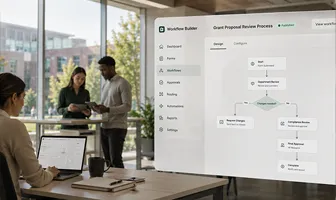
Discover how Kuali connects the work behind administration, research, compliance, IT, and more.
Explore Kuali solutions ->%2520(1).jpeg)
Without a centralized research administration system, Portland State University relied on shadow systems, individual tracking methods, and manual communication to keep research moving. By implementing Kuali Research, the university gained greater transparency, automated workflows, and a connected view of research operations across the institution.

Learn how to enable regular business users to create powerful research administration forms and workflow processes without relying for IT. Read more here.

The University of Baltimore replaced paper-based research administration with connected digital workflows that improved visibility, accelerated approvals, and reduced administrative burden. By implementing Kuali Research, the university transformed proposal development, awards management, and compliance processes into a faster, more transparent experience for researchers and administrators alike.…