

The Institutional Biosafety Committee (IBC) reviews any proposed research involving the use of biological items like recombinant DNA, select agents, bloodborne pathogens, or other areas, depending on your institution. Before an investigator can begin a research project involving these items, they must first go through an IBC approval process. This means that the committee evaluates the investigator’s application to ensure that appropriate biosafety plans are in place and that researchers will follow IBC protocols.
IBC reviews and Institutional Review Board (IRB) reviews are very similar, but they have some distinct differences. For both, committee makeup is prescribed by the applicable regulations.
Because research projects dealing with biohazardous material or genetic engineering can also involve human participants, such experiments would need to be approved by both IBC and IRB.
When submitting applications, be sure to be as specific and detailed as possible to avoid possible delays in the IBC approval process. The more details you can provide about the project you plan to work on, the easier it will be for the IBC to evaluate your application and determine the risk involved and whether or not you have the proper biosafety plan to handle the risk.
Pay special attention to how you write your application, and keep your intended audience in mind. The IBC consists of scientists, non-scientists, and members of the public, and some of them could be unfamiliar with science or lab jargon. Make sure that your application can be easily understood by all members of the IBC.
If there is any missing information or your application needs any revisions, the IBC will send it back to you. Responding and resubmitting your application as soon as possible will prevent further delays.
Once you have completed and submitted an application, a staff review is performed to ensure the application is complete and consistent. It then moves on to a committee review where they evaluate the description of the proposed project, including the safety risks associated with both the biological elements involved and the techniques that will be used, as well as the biosafety containment plan.
Members of the IBC typically meet monthly for careful review of all applications that have been submitted for review. After review, the members vote on the outcome. Voting options include:
Kuali provides modern software with a modular solution for the whole research lifecycle — including the IBC approval process. Using the correct Electronic Research Administration software can help reduce risk, improve efficiency, and increase the effectiveness of the research process. Learn more about Kuali Research today to see how our software can enhance your institution’s IBC approval process, or check out our resource library to learn more about other parts of the research process.
Kuali is software for the future of higher education.
Recognized as a leader in higher education software, Kuali has been creating innovative solutions exclusively for higher ed for more than 20 years. Kuali delivers affordable, modular cloud solutions that enhance institutions’ teaching and research missions. The Kuali suite includes Kuali Research for research administration, Kuali Academic Operations to manage curriculum catalogs and syllabus creation, Kuali Build for no-code online forms and workflow automation, Kuali Financials for financial management, and Kuali Ready for robust business continuity planning. Trusted by hundreds of institutions, Kuali supports higher education's drive toward efficiency, compliance, and innovation.
For more information, visit kuali.co.
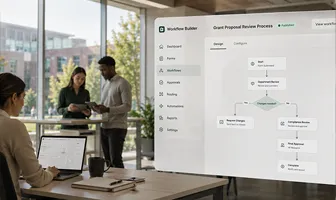
Discover how Kuali connects the work behind administration, research, compliance, IT, and more.
Explore Kuali solutions ->%2520(1).jpeg)
Without a centralized research administration system, Portland State University relied on shadow systems, individual tracking methods, and manual communication to keep research moving. By implementing Kuali Research, the university gained greater transparency, automated workflows, and a connected view of research operations across the institution.

Learn how to enable regular business users to create powerful research administration forms and workflow processes without relying for IT. Read more here.
The University of Baltimore replaced paper-based research administration with connected digital workflows that improved visibility, accelerated approvals, and reduced administrative burden. By implementing Kuali Research, the university transformed proposal development, awards management, and compliance processes into a faster, more transparent experience for researchers and administrators alike.…