Kuali Reach (formerly Penji) is a mobile-first student success platform that brings tutoring, advising, coaching, scheduling, outreach, and student engagement together—making it easier for students to get help and giving Student Success teams the visibility to understand, manage, and expand the support they provide.
Colleges already invest in advisors, tutors, coaches, and student support programs. The challenge is making those resources easy for students to use—and giving leaders the information they need to understand what is working. Kuali Reach brings scheduling, communications, attendance, student history, and real-time reporting together so Student Success teams can coordinate support and increase student engagement.

Let students self-schedule appointments, join groups, use drop-in support, and find available resources without email back-and-forth.

Coordinate tutor and advisor availability, appointments, groups, locations, and services across one or multiple support centers.

Use SIS data and student attributes to reach specific students with timely nudges that encourage them to schedule, attend, or take the next step.

Track whether students actually show up through appointment attendance, tutor-led logging, and student self check-in.

Track engagement through QR codes and configurable kiosks. Measure utilization across virtually any campus resource, service, event, or student support program.

Bring student usage, tutor and advisor utilization, appointment activity, attendance, and engagement into one consistent data set—with interactive dashboards instead of disconnected spreadsheets and session logs.

Less confusion about where to go for support.
Less manual scheduling, attendance tracking, session logging, and reporting for support teams.
Greater visibility into which services students use, where demand is growing, and where additional follow-up or capacity may be needed.
More students connected to support. Better visibility into engagement and demand. A stronger foundation for growing the services that help students succeed.
Students shouldn’t have to understand the organizational chart of their institution to get help. Reach gives students a mobile-first place to find available support, schedule appointments, join groups, view drop-in options, receive reminders, and stay connected to the services designed to help them succeed.
Robert Hamill — Bridgewater College
Student support works best when the people seeking help, the people providing it, and the teams coordinating it all work from the same experience.

Find tutoring, advising, coaching, and other support; schedule appointments; join groups
or drop-in sessions; receive reminders; and stay connected through a mobile-first experience.
Set availability, manage appointments and sessions, capture notes and attendance, communicate with students, and see relevant student history in one place.
Coordinate schedules and services,
understand demand, track attendance and utilization, measure engagement, and make
better-informed decisions about staffing and support.
From finding support to measuring engagement, Reach connects the student experience with the work happening behind the scenes.
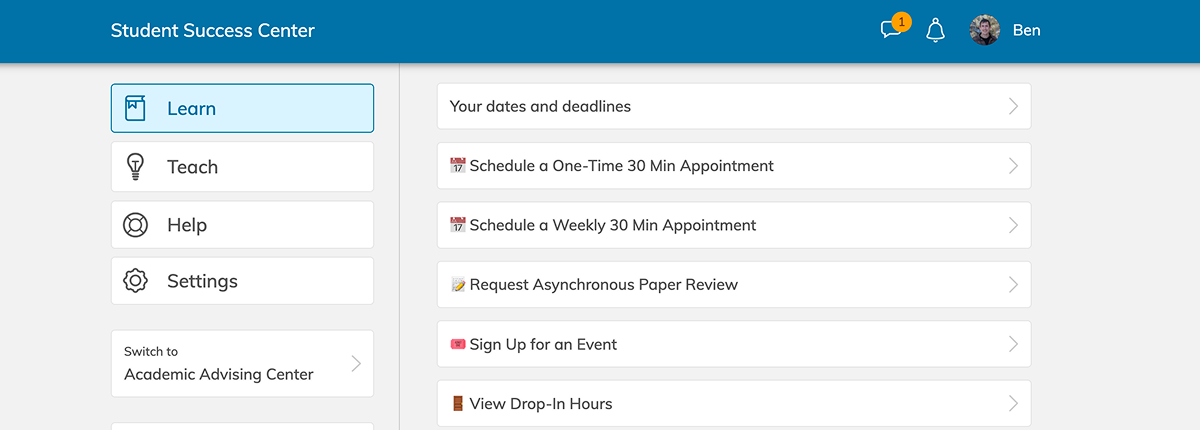
Students discover tutoring, advising, coaching, groups, drop-in hours, and other resources and schedule directly from web or mobile.
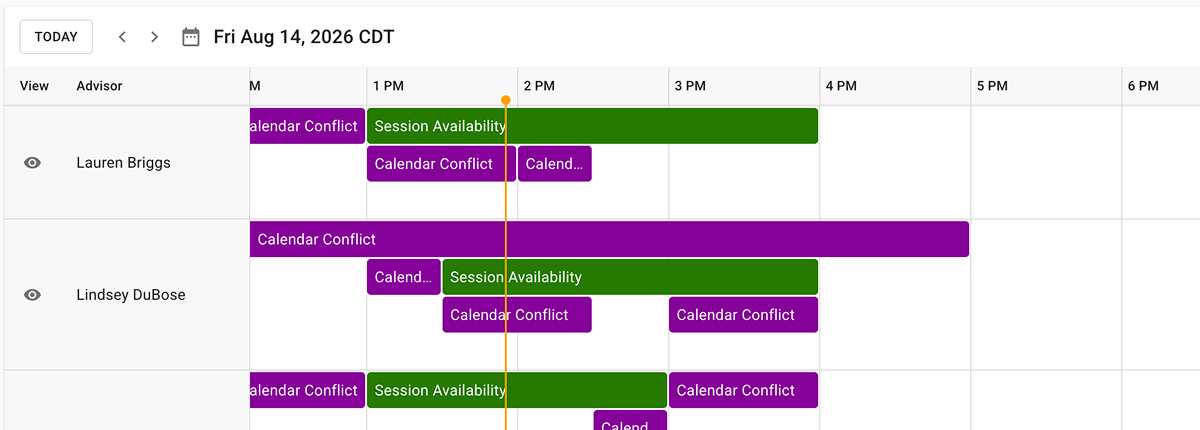
Tutors and staff set availability while center leaders coordinate schedules, locations, services, and capacity.
.png)
Capture appointment and event attendance through flexible check-in methods, including student self check-in and QR-supported experiences.
Capture appointment and event attendance through flexible check-in methods, including student self check-in and QR-supported experiences.
.png)
Students discover tutoring, advising, coaching, groups, drop-in hours, and other resources and schedule directly from web or mobile.
Students discover tutoring, advising, coaching, groups, drop-in hours, and other resources and schedule directly from web or mobile.

Tutors and staff set availability while center leaders coordinate schedules, locations, services, and capacity.

Capture appointment and event attendance through flexible check-in methods, including student self check-in and QR-supported experiences.

Send targeted text and email outreach that moves students toward meaningful actions such as scheduling an appointment or attending an event.
Track appointments, attendance, student history, tutor utilization, and service demand in real time.
Tutoring centers are dynamic operations. Demand changes by course, time of day, location, and point in the semester. Without reliable usage data, it can be difficult to know whether tutors are being fully utilized—or where more capacity is needed. Kuali Reach gives Student Success and tutoring leaders a real-time view of the center: who is available, what students are scheduling, who is showing up, which tutors and subjects are in demand, and how support resources are being used.
Coordinate tutor availability, appointments, groups, drop-in services, and locations.
See how often tutors and services are being used and identify gaps or growing demand.
Know whether scheduled students actually engage with the support they requested.
Use real usage data to inform staffing, hours, services, and conversations about expanding student support.
Sarah Jeffrey — Senior Coordinator of Peer Education (PLaTO), University of Georgia
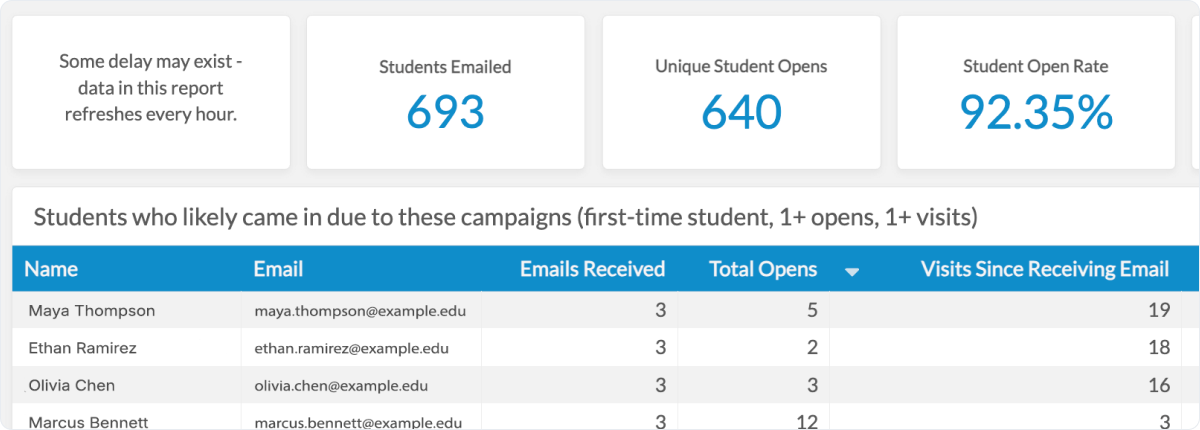
Student success is not measured by how many emails or texts were sent. What matters is whether students take action. Reach connects communication with scheduling and attendance, helping teams understand what happens after the message is delivered.
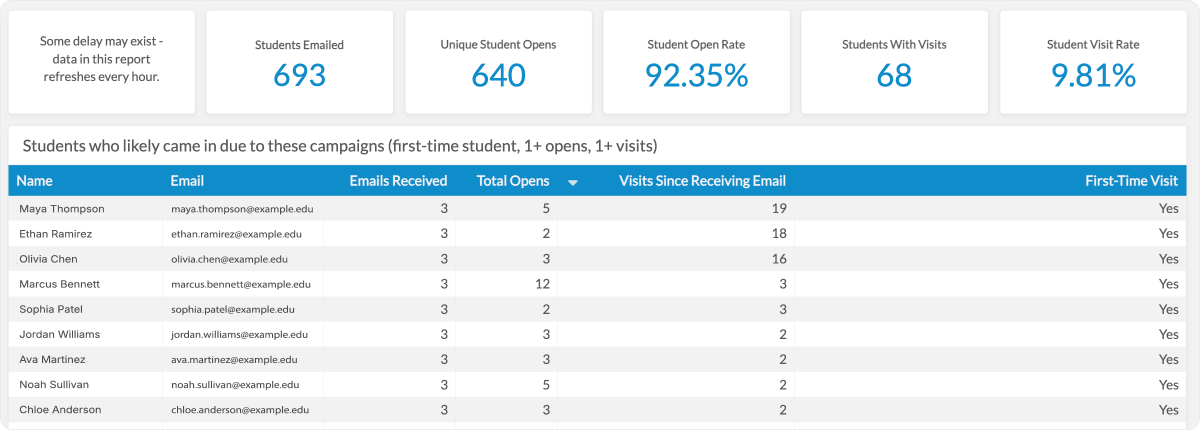
Target students using SIS attributes, academic milestones, programs, courses, class year, enrollment status, and other relevant criteria.
Give students a direct path from the message to scheduling, event registration, tasks, or other support actions.
Use reminders and check-in tools to help close the gap between a scheduled appointment and an attended appointment.
See which outreach is driving appointments and participation—and which students may need additional follow-up.
Text and email nudges can help Student Success teams turn outreach into action—especially when the message gives students a direct path to the next step.

Reported a 40% higher first-year experience event attendance after bulk texting.

Reported 52% more first-year advising appointments completed after adding texting.
Advisors need more than another calendar. Reach brings scheduling, notes, student history, communications, and attendance together so advisors can spend less time coordinating appointments and more time helping students make decisions.
Let students choose available times without back-and-forth email.
Connect advisor availability with supported institutional calendar tools to reduce double-booking and manual coordination.
Review prior interactions and capture session notes in the same place appointments are managed.
Use text and email nudges to encourage students to schedule, attend, and take the next step.
The goal is not simply to fill calendars. It is to help more students use the resources institutions already invest in—and give leaders the evidence to improve and expand those resources over time. A stronger student experience can increase awareness and usage. Attendance and utilization data show where demand is growing. Student Success leaders can then use that insight to adjust hours, staffing, tutor capacity, and services.
Sarah Jeffrey — Senior Coordinator of Peer Education (PLaTO), University of Georgia
Laura Arroyo — Assistant Vice Chancellor for Transitions and Academic Partnerships, University of Colorado Boulder
The student-support platform institutions know as Penji is becoming Kuali Reach as part of Kuali's broader Student Success offering. The new name reflects the same core mission: helping institutions reach students with the people, resources, and support they need to keep moving forward.

Access the Higher Ed's Guide to Curriculum Management Software with Kuali. Discover best practices & tips for selecting the right software for your institution
Read the ebook →
Learn about how UCF's Provost's Office solved for their curriculum management data issues with their catalog using Kuali.
Read the case study →
Curriculum management today is far more complex than simply updating course catalogs. Learn how Kuali assists with the complexity.
Read the blog →See how Kuali Reach can help your institution coordinate tutoring, advising,
coaching, outreach, scheduling, and engagement—while giving Student Success
leaders the visibility to understand and grow the support students use.


