

For decades, Microsoft Word documents and PDF forms have quietly powered many of higher education’s most important administrative processes. From change-of-major requests to hiring paperwork and internal approvals, these tools became the default not because they were ideal, but because they were familiar and universally available. Over time, however, institutions have begun to recognize that familiarity does not necessarily equate to effectiveness.
Research consistently shows that Word- and PDF-based forms remain deeply embedded in higher education workflows. According to a 2021 report by Kuali, The State of Forms in Higher Education, 80% of respondents reported using Microsoft Word to create new forms, while 66% relied on PDFs. Yet those same respondents also described growing frustration with lost submissions, duplicated data entry, unclear approval paths, and long processing times - all symptoms of tools that were never designed to support modern, end-to-end workflows.
As institutions face increasing pressure to enhance the student experience, reduce administrative burdens, and operate with leaner teams, the limitations of static documents have become increasingly difficult to ignore. Forms are no longer just about collecting information; they are often the starting point for complex, multi-step processes that require routing, validation, transparency, and accountability.
Word and PDF forms introduce friction at nearly every stage of a process. Submissions frequently require printing, scanning, or manual email distribution. Data must be re-entered into downstream systems. Approvers spend time searching inboxes for the latest version of a document or trying to determine why a request has stalled.
According to EDUCAUSE, digital transformation efforts in higher education are increasingly focused on operational efficiency and resilience, particularly as institutions manage staffing shortages and rising expectations from students and faculty. Yet static forms often undermine those goals by reinforcing manual work and opaque processes.
The impact is measurable. Gartner research has shown that inefficient workflows and excessive manual intervention can significantly slow institutional responsiveness, while increasing operational risk. In higher education, where many processes involve compliance, approvals, and sensitive data, the cost of inefficiency extends beyond time - it affects trust, accuracy, and institutional credibility.
If Word and PDFs cause so many issues, why do they persist? The answer is less about resistance to change and more about access. Many staff members turn to tools they already know because requesting something better often requires IT involvement, long queues, or complex implementations.
The State of Forms in Higher Education report found that 65% of form creators rely on IT to help build or deploy new forms. When IT bandwidth is limited, departments often default to familiar tools, even when they know those tools are insufficient. This creates a cycle where inefficient processes are tolerated simply because improving them feels out of reach.
That dynamic is changing. Cloud-based, no-code platforms are enabling non-technical staff to design and manage forms and workflows independently without compromising security, accessibility, or governance. Institutions are beginning to recognize that empowering functional experts to improve their own processes is one of the most scalable ways to modernize campus operations.
Today’s administrative forms often initiate processes that span departments, systems, and stakeholders. A single submission might require conditional logic, multiple approvals, automated notifications, and integration with systems of record. Static documents struggle to support even modest complexity, let alone processes that evolve over time.
Modern forms increasingly need to:
This is why many institutions are rethinking forms not as standalone documents, but as the front door to automated workflows. The form becomes part of a larger ecosystem that supports consistency, accountability, and a better experience for everyone involved.
Across higher education, institutions are adopting platforms that combine form building with workflow automation. These tools sit between overly simplistic form builders and highly technical enterprise systems, offering enough power to handle real-world complexity while remaining accessible to non-developers.
The State of Forms in Higher Education report found that nearly half of all form-based processes are “somewhat complex” or “complex,” involving multiple approvals and conditional routing. That reality has made it increasingly difficult to justify tools that stop functioning once a form is submitted.
Institutions that successfully modernize forms often report faster turnaround times, fewer errors, and improved transparency - outcomes that directly support student success and staff effectiveness.
As higher education continues its shift away from Word and PDF-based forms, platforms like Kuali Build are explicitly designed to meet the needs institutions face today. Kuali Build allows campus teams to create accessible, secure, cloud-based forms and connect them to automated workflows - without requiring coding or heavy IT involvement.
Institutions such as Southern Illinois University Edwardsville and Fresno State University have utilized Kuali Build to replace paper and PDF-driven processes with digital workflows that reduce processing time, increase visibility, and improve the overall experience for students and staff.
For teams exploring how to move beyond static forms without overcomplicating their technology stack, starting with forms and workflow automation can be one of the most practical and impactful steps to take.
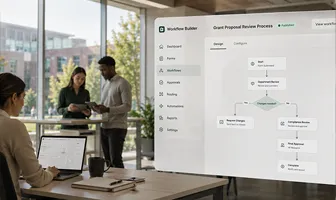
Discover how Kuali connects the work behind administration, research, compliance, IT, and more.
Explore Kuali solutions ->
Leeward Community College was outgrowing its homegrown curriculum management solution. With Kuali Curriculum Management, Leeward significantly enhanced the user experience for faculty and admins and delivered improved curriculum for students.

Indiana University replaced a homegrown continuity system with Kuali Ready and now manages 800 active business continuity plans across every campus. See how one standardized platform gave IU a single training and support model while still flexing for campus-specific needs.
Higher education leaders across the nation are investing time and money into digital transformation. But many face a common problem: How do we create sustainable, strategically driven change? Davidson College accelerated digital transformation by building a team; Kuali Build has been an instrumental software in their success.