

Academic research naturally requires extensive documentation and administrative processes. Despite advancements in digital tools, many institutions still rely heavily on manual methods. Automating these processes can significantly enhance efficiency, reduce errors, and free up valuable time for researchers and administrators.
Kuali Build is a powerful, scalable solution designed to help institutions automate forms and workflows within the research department. Let's explore five modern ways to leverage Kuali Build for automating research processes.
Faculty members often need to request Principal Investigator (PI) status to lead research projects. Traditionally, this involves filling out forms with personal and project details, followed by multiple levels of approval. This process can be time-consuming and prone to errors.
With Kuali Build, institutions can integrate with existing campus systems to auto-populate form fields, reducing manual entry and errors. For instance, when a faculty member logs in using Single Sign-On (SSO), their name, department, and email address can automatically populate the form. Additional project details like protocol numbers and sponsors can also be fetched from integrated systems.
By automating the PI status request process, institutions can significantly reduce processing time and improve data accuracy.
Learn more about integrating users and groups in Kuali Build:
Research projects don't always adhere to initial timelines, necessitating no-cost extensions. The forms for such requests often include multiple conditional fields, making them complex and cumbersome.
Kuali Build allows for the incorporation of conditional logic into forms. Fields can appear or remain hidden based on user responses, simplifying the form-filling experience. For example, if a user indicates that human subjects are involved, additional fields related to protocol numbers and approval dates can dynamically appear.
This dynamic approach not only simplifies the user experience but also reduces the likelihood of errors, ensuring that administrators spend less time correcting forms.
Explore how to create and manage roles for form permissions:
An Award Memorandum of Understanding (MOU) is crucial for establishing research or educational partnerships. Traditionally, managing MOUs involves lengthy forms, multiple departmental approvals, and the possibility of documents being sent back for revisions.
Kuali Build addresses these challenges by enabling branching workflows with conditional formatting. For instance, the University of Massachusetts Amherst utilized Kuali Build to automate their MOU process, accommodating multiple Co-Principal Investigators (Co-PIs) and their respective departments. The system automatically routes approvals based on the number of PIs and Co-PIs involved and their departmental affiliations.
This automation reduces administrative burden and ensures a more efficient MOU process.
Learn more about managing groups in Kuali Build:
Faculty members contributing to sponsored research projects may be eligible for supplemental pay. However, processing these payments can be delayed due to manual workflows.
Southern Connecticut State University faced such challenges, with delays caused by lost paperwork and manual data entry errors. By implementing Kuali Build, they streamlined the supplemental pay request process. Approvers receive email notifications and can approve requests with a single click. Administrators can track the progress of each form, identifying any bottlenecks in the approval process.
As a result, the institution now releases funds within two weeks of form submissions, saving an estimated $675,000 by reallocating staff time from manual processing to more strategic tasks.
Read the full case study on Southern Connecticut State University's experience
Occasionally, research departments need to quickly implement new processes in response to urgent situations. For example, during the COVID-19 pandemic, institutions had to rapidly develop protocols for returning to research activities.
Davidson College leveraged Kuali Build to swiftly create and deploy processes for tracking COVID-19 testing data. The platform's user-friendly interface allowed for quick setup, and its flexibility enabled the institution to adapt to evolving guidelines and policies.
Kuali Build's capacity for rapid deployment ensures that institutions can respond effectively to urgent needs without compromising on compliance or efficiency.
Discover more about Kuali Build's capabilities
Kuali Build offers a robust platform for automating various research processes, from PI status requests to supplemental pay approvals. By integrating with existing campus systems and providing flexible workflow options, Kuali Build empowers institutions to enhance efficiency, reduce errors, and focus on advancing research initiatives.
Learn more about how Kuali Build can transform your research administration
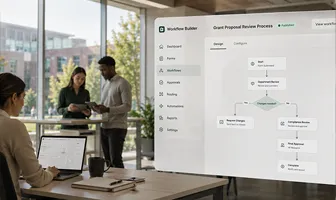
Discover how Kuali connects the work behind administration, research, compliance, IT, and more.
Explore Kuali solutions ->%2520(1).jpeg)
Without a centralized research administration system, Portland State University relied on shadow systems, individual tracking methods, and manual communication to keep research moving. By implementing Kuali Research, the university gained greater transparency, automated workflows, and a connected view of research operations across the institution.

Learn how to enable regular business users to create powerful research administration forms and workflow processes without relying for IT. Read more here.
The University of Baltimore replaced paper-based research administration with connected digital workflows that improved visibility, accelerated approvals, and reduced administrative burden. By implementing Kuali Research, the university transformed proposal development, awards management, and compliance processes into a faster, more transparent experience for researchers and administrators alike.…