

Administrative forms are everywhere on campus - from onboarding new hires to navigating student services to internal approvals for finance, curriculum, or research. But static paper forms and email chains slow processes, increase errors, and bury teams in repetitive work that adds little strategic value. The solution? A form builder with workflow automation that turns once-manual processes into efficient, transparent digital experiences - without hours of custom coding.
A form automation platform becomes especially valuable when common workflow challenges begin to surface across campus, a pattern higher education leaders increasingly point to as a signal for administrative simplification.
When you see one or more of these patterns, a smart form builder - one that includes workflow automation - can drastically improve efficiency and reduce administrative friction. Digital forms also enable consistent data capture and can have accessibility built in from the start.
Below are five common administrative processes where universities have seen measurable improvements by automating forms and approvals.
What: Processes like course add/drop forms, change-of-major requests, and petition forms are often paper-driven or managed through email.
Why automation helps: These forms typically receive high volumes of submissions each semester, and they often require multiple approvals (advisor, registrar, dean). An automated form can:
For example, modern universities digitize curriculum and academic approval forms to reduce hours spent chasing signatures and ensure students get timely responses.
Results: With automated form workflows, institutions can reduce turnaround times from weeks to days or even hours.
What: Internal approvals - such as budget requests, travel reimbursements, or staff expense authorization - are classic paper-dependent processes that require multiple departmental sign-offs.
Why automation helps: By turning these into online forms with automated routing:
Institutions using automated workflows report significant reductions in administrative workload and improved accuracy compared with manual systems. Automating internal approvals also lets operational leaders focus time on strategic work instead of chasing signatures.
What: Hiring forms for faculty, adjuncts, or staff appointments often involve lengthy documents, multiple departments, and detailed compliance checks.
Why automation helps: Manual hiring forms can take weeks to route, requiring follow-ups at every step. When automated:
Western University - for example - automated their faculty hiring approvals with a form builder and reduced turnaround times dramatically. Prior to automation, the approval process took multiple weeks; after implementation, many approvals were complete in a single day.
What: Research proposals, grant budget approvals, conflict of interest disclosures, and safety compliance attestations are often complex and prone to error if processed manually.
Why automation helps: Research administration offices juggle many interdependent steps. Automated forms ensure:
Institutions that adopt form automation here reduce the risk of incomplete submissions and support researchers with faster turnarounds - a win for compliance and efficiency.
What: Requests like facility reservations, IT access requests, student account updates, or event planning involve forms that often sit in individual inboxes or spreadsheets.
Why automation helps: Instead of inefficient manual routing, an automated form allows:
Automated campus service request forms reduce operational drag and give service centers the ability to prioritize based on real timing and volume.
Platforms designed for higher education take form automation further by building forms that integrate with student and staff directories, enable conditional logic, and route approvals based on roles rather than manual assignment. Many allow business users to build and update forms themselves without IT intervention - reducing backlog and decentralizing simple process improvements. These tools often include drag-and-drop builders, conditional logic, automated emails, and workflow dashboards so teams can see what’s happening in real time. This approach aligns with broader trends in university administration: institutions are embracing digital and automated workflows across admissions, HR, finance, and operations to reduce manual work and focus staff effort on high-value tasks.
If your institution regularly relies on paper forms, manual email routing, or spreadsheets for approval tracking, you likely have several processes that could benefit from automation. Examples like academic requests, internal approvals, hiring forms, research compliance, and campus services are just the beginning.
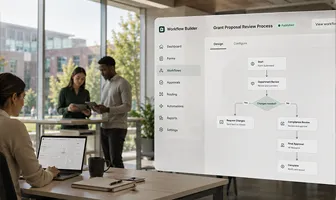
For campuses ready to modernize, tools like Kuali Build - a no-code form and workflow automation platform built specifically for higher education - give teams the power to create online forms, automate routing, add conditional logic, and track progress without writing code. With a drag-and-drop interface and built-in workflow automation, teams can launch automated forms in minutes and accelerate approvals that once took weeks or months.
For teams still figuring out where to begin, Kuali’s ebook, The Higher Ed Guide to Automation and Workflow Tools, offers a practical overview of how colleges and universities approach automation. It breaks down common use cases, explains how workflow tools fit alongside existing campus systems, and provides guidance on selecting the right automation approach for your institution.
Discover how Kuali connects the work behind administration, research, compliance, IT, and more.
Explore Kuali solutions ->
Leeward Community College was outgrowing its homegrown curriculum management solution. With Kuali Curriculum Management, Leeward significantly enhanced the user experience for faculty and admins and delivered improved curriculum for students.

Indiana University replaced a homegrown continuity system with Kuali Ready and now manages 800 active business continuity plans across every campus. See how one standardized platform gave IU a single training and support model while still flexing for campus-specific needs.
Higher education leaders across the nation are investing time and money into digital transformation. But many face a common problem: How do we create sustainable, strategically driven change? Davidson College accelerated digital transformation by building a team; Kuali Build has been an instrumental software in their success.