Tarleton State University set out to modernize campus workflows. Like many institutions, they were managing a patchwork of forms and tools while a growing queue of workflow requests piled up in Central IT. Rather than hiring their way out, Tarleton changed the operating model. Central IT focused on governance and the technical foundation, while functional teams built and improved workflows closer to the work.
With Kuali Build, Tarleton consolidated disparate solutions, moved critical processes out of email and PDFs, and accelerated campus-wide adoption through a cross-functional cohort approach. They also maintained appropriate oversight for complex workflows.

Before adopting Kuali Build, Tarleton’s workflow landscape was fragmented. Teams were using a mix of forms and point solutions across campus. The result was an inconsistent experience and a difficult environment for scaling process improvement.
At the same time, demand for new and improved workflows was outpacing Central IT’s capacity. Requests accumulated quickly, creating a backlog the team knew they couldn’t sustain.
“The real change was cultural. Instead of departments waiting in line for IT, they became builders within a structured framework. Kuali Build allowed us to democratize automation while keeping compliance, data stewardship, and integration standards intact.”
— Justin Carrell, Director of Continuous Improvement
There was also a compounding issue. Workflows often were not connected to systems of record. Users were repeatedly asked for data that already existed, and sometimes different systems did not match, creating cleanup work and uncertainty.
In short:
Tarleton’s leadership recognized that scaling digital transformation required changing how work was shared between Central IT and business units. Instead of central IT building every workflow, the team invested in integration and a governed foundation that others could build on.
“We made a deliberate shift. Instead of building every workflow ourselves, we focused on designing the integration architecture and governance model that workflows run on. Once that foundation was in place, the campus could innovate safely within a connected ecosystem.”
— Justin Carrell, Director of Continuous Improvement
To accelerate adoption, Tarleton brought a cohort of roughly 20 people into onboarding and early build efforts. They intentionally included high-impact areas such as financial aid, admissions, and the registrar’s office. That approach created shared momentum, aligned priorities across functions, and established early champions who could help expand adoption.
Tarleton also moved quickly from exploration to execution.
“We asked if we could get a Kuali Build sandbox. We got a sandbox within an hour or so, and then we started working in it…and went to production with the forms we created at launch….”
— Jo Ann Kern, Director of the Office of Transformation Realization
This model delivered two benefits simultaneously. It reduced IT bottlenecks by shifting the creation of appropriate workflows closer to process owners. It also improved data quality and user experience by connecting workflows to systems of record.
One early win came from the registrar’s office, where the team stood up multiple workflows and replaced manual routing with structured, trackable processes. As adoption grew, Tarleton expanded beyond single-department use cases to tackle cross-functional workflows that previously lived in email threads and inboxes. These are the kinds of processes that are hard to track, difficult to audit, and easy to stall.
Jo Ann described the broader impact of modernizing these processes:
“We tend to push a lot of paper around. The work we’re doing with Kuali is eliminating those paper trails, and as we eliminate them, the processes become more effective, more efficient, and most importantly, more transparent.”
— Jo Ann Kern, Director of the Office of Transformation Realization
Importantly, Tarleton did not treat distributed workflow building as a blanket rule. They took a practical approach. Some workflows were ideal to distribute to functional teams, while others warranted additional oversight due to complexity, risk, or cross-campus impact.
Tarleton emphasized that integration is where the payoff happens. Integrations reduce re-keying, minimize errors, and keep information current by referencing authoritative data. Instead of asking users to repeatedly enter information, workflows can draw from systems of record and keep processes aligned across platforms.
Tarleton reported integrating with six systems. They also worked to push data back into systems of record where feasible.
Tarleton’s approach created meaningful operational impact across campus:
And as Jo Ann summed up the long-term impact of changing the model:
“We realized we couldn’t scale transformation by having central IT build every workflow, so we shifted to a citizen development model.”
— Jo Ann Kern, Director of the Office of Transformation Realization
Use distributed workflow building thoughtfully. Distribute what you can and add oversight where you need it.
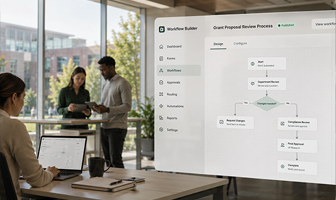
Discover how Kuali connects the work behind administration, research, compliance, IT, and more.
Explore Kuali solutions ->UConn transformed its administrative processes using Kuali Build, a no-code online forms and workflow automation tool. By empowering citizen developers, the university streamlined operations, reduced IT bottlenecks, and accelerated digital transformation, improving efficiency across campus.
This page showcases a case study of how Colorado State University used Kuali Build to streamline and automate their form and workflow processes.


